
Nothing but Water

Nothing but Water
We lost a(nother) gallery client last week. Helga, not her real name, didn't like “the mixture of art and political topics” on our platform. I think she didn't mind the Ukraine stuff, just, you know…the Arabs. My students in Vienna used to get furious when I brought up the art market, pricing, and career prospects. How dare I sully art with the mundane? Art is the white woman's virtue in this scenario, meant to be protected at all costs. A chastity belt for the status quo, if you wish. How dare I besmirch art with dead bodies? How dare I mention labor issues? Please, no blood in my cocktail; I will have my fear straight. Fear of losing clients, fear of being ostracized, fear of being called an antisemite. I would rather support fascism instead! I will keep my head down and aspire to be a rich white artist who abuses his assistants, too. Or, worst-case scenario, I will get an art professorship and try not to mess up pronouns too much until retirement.
Yet the dead bodies pile up. Yet the dead bodies pile the fuck up.
It has been two years today.
Oh, but Staatsräson, you will say. We Germans passed on the mantle of ethnonationalism to our victims; this way, all the Jews can be over there and not here! Everyone is allowed one genocide in their lifetime, ja? Now it is their turn (we have done a couple*, but shhh). We promised to protect Jewish supremacy as if it were our own, and you know we are the best at being bad. This way, we are not really forced to return anyone's stolen fortunes or pay substantial reparations or even convict but a sample of the Nazi war criminals, nor really come to terms with the fact that supremacy is part of the German psyche. Heiresses of families who made fortunes during the Holocaust can open up art institutions and support diversity. All is in the past, sealed, institutionalized. Never Again.
(Well, except for all that plastic and e-waste we sent to African countries.)
It has been two years and 75 years.
Have you read Omar el Akkad's One Day, Everyone Will Have Always Been Against This? He questions the point of any art created in a time of genocide that doesn’t condemn it. I have thought of that often, as I self-censor myself in the studio. Everything I put on canvas looked like bombed-out buildings for a while. How can I show but not tell? How can I tell but keep on selling? How can I tell without YELLING!
One day, everyone Will Have Always Been Against this. One day, art condemning the Palestinian Genocide will be in a museum, hey, probably on Documenta too. But for now, it is the Code of Conduct for you.
Or maybe one day, you will come to understand that it is not Jewish people you are defending with your silence, but the right to supremacy. One day, when the AfD is the first party in Germany, we will get to call Staaträson what it really is again: Germany for the Germans.
Art is not meant to convey a specific message; there are many better-suited mediums for that purpose, such as design, for example, the written word, etc. Art can, however, open up corridors; it can open up space in our imagination for the new, the unexpected, the never-before-seen or thought of. It can also hold tension for the truth when it is uncomfortable. There is no justification for Genocide. There is no justification for inaction during a Genocide.
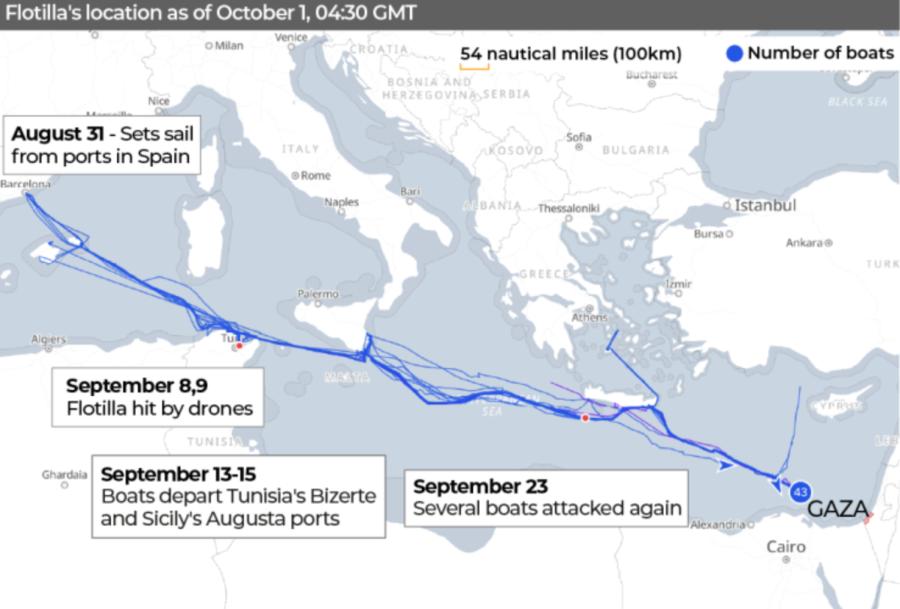
And I think the Global Sumud Flotilla did exactly that. It visualized for those of us who care to look how CLOSE all these countries are to Gaza. The activists repeated the words “build a humanitarian corridor at sea,” and every time I heard it, I could breathe again. Greece, Cyprus, Turkey, and Egypt are a breath away. A breath! Italy, Spain, and the rest of Europe are not very far behind, and there is nothing, nothing standing in the way of us helping the starving Palestinian population, nothing but water.
* from wikipedia: The Herero and Nama genocide or Namibian genocide,[5] formerly known also as the Herero and Namaqua genocide, was a campaign of ethnic extermination and collective punishment waged against the Herero (Ovaherero) and the Nama people in German South West Africa (now Namibia) by the German Empire. It was one of the earliest genocides to begin in the 20th century, occurring between 1904 and 1908.