It was never really that good
It was never really that good
In a deliberate mistranslation of a line from Nino Ferrer’s 1975 hit Le Sud, the title of Basma al-Sharif’s solo exhibition at soft power turns the song’s melancholic sigh for a lost paradise (“C’était pourtant bien” – “it was good though”) into a sharp political reckoning that refuses nostalgic amnesia: It was never really that good.
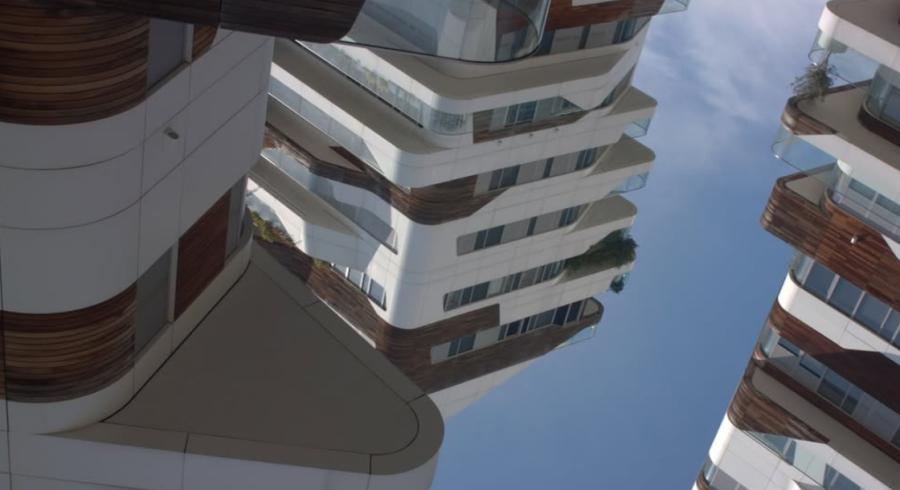
In two video installations, the exhibition exposes how both integration policy and the neo-colonial promise of progress function as tools of ideological conformity that dictate conditional belonging. Addressing the diasporic condition of her own biography, the Palestinian artist anchors this inquiry in a multilayered exploration of displacement and complicity. Separation anxiety is the focal point of al-Sharif’s latest short 16mm film, Morgenkreis (Morning Circle) (2025, 20 min.), where geopolitical displacement finds a visceral parallel in the universal, formative experience of a child’s separation from their parent at the kindergarten door. Presented as a large-scale projection, the work follows an Armenian-Lebanese father and son through their morning routine. Set to a slowed-down version of the Al Jazeera theme music, the camera moves between dusky Berlin cityscapes, the family’s domestic environment, and glimpses of a television screen broadcasting footage of erased landscapes in Gaza. Their arrival at a Berlin daycare is mirrored in the exhibition space by a large red carpet that evokes the soft social ritual of the “morning circle” featured in the film as a pedagogical method. The quiet distress of the child clinging to his father at the door is repeatedly pierced by an intrusive, off-camera interrogation of a state bureaucrat checking the parameters of the family’s assimilation and alignment with a German “way of life.” As the film culminates with the boy spinning free on a Berlin playground, the scene is overlaid with news footage of tens of thousands of Gazans returning on foot to the North of the strip after the failed ceasefire of January 2025. By weaving these direct fragments of contemporary trauma into the fabric of an apparently innocent, pedagogical ritual designed as a primary transition of a child into society, al-Sharif’s film resists generalizing the narrative into a passive experience of migration (or parenthood). Instead, through the motif of the kindergarten, the artist exposes the subtle brutality of an integration policy that expects individuals to align themselves with a system that simultaneously denies their heritage, language, and political agency. This systemic expectation of conformity takes on a seductive guise in Capital (2023, 19 min.). Adopting a satirical approach to corporate visual languages, the installation comprises a two-channel video and a series of banners depicting architectural renderings of proposed urban spaces, soundtracked by the Ferrer song echoed in the exhibition’s title. The work references the Telefoni Bianchi (“White Telephone”) cinema of 1930s and ’40s fascist Italy: escapist, glamorous films that promoted conservative, nationalistic notions of home and wealthy domestic harmony while obscuring totalitarian violence and social conflict. Adopting these historical tropes, the film’s narrative is navigated by a female protagonist who embodies the image of the ideal resident – compliant and filled with desire. Al-Sharif confronts these historical cinematic strategies with contemporary backdrops of urban privatization shot across the CityLife residential complex in Milan, the Nile riverfront in Cairo, and the construction sites of Egypt’s new luxury developments; gated environments where architectural histories are romanticized even as they are being erased. Set against the rigid fascist aesthetic evoked by the hanging banners, the film’s use of ventriloquism – detaching one’s voice from the body by projecting it into an object, here a handpuppet – takes on an unsettling quality. By transforming the puppet into a surrogate dummy (that appears to speak with a sharper, more critical intelligence than its human handler), al-Sharif investigates the sinister intimacy between urban hyper-capitalism and the reality of authoritarian censorship. Retaining a childlike innocence, the handpuppet itself subverts the act of parroting; it can articulate the structural truths its speaker may be unable, or unwilling, to utter without facing censure. Removed from its on-screen reality, this prop creates a link between the two filmic environments al-Sharif presents in the exhibition. In German, indeed the term “Requisit” further highlights the prop’s status as a prerequisite to sustain an ideological fiction. Required for the elaboration of narrative continuity, its stubborn material presence in the space threatens to undermine the cinematic illusion, cracking open the polished surface of the stories we are told.
About the artist:
Basma al-Sharif works across film, installation, writing and photography. Using precise visual language, dark humour, and attention to landscape and sound, the Palestinian artist and filmmaker creates lyrical, poetic works which address ongoing violence and its representation, exploring the legacy of colonialism within inescapable power systems. Al-Sharif received an MFA from the University of Illinois at Chicago in 2007, was a resident of the Fondazione Antonio Ratti in 2009 and the Pavillon Neuflize OBC at the Palais de Tokyo in 2014-15. She received a Jury prize at the Sharjah Biennial in 2009, was awarded a Visual Arts of the Fundación Botín in 2010, and Mophradat’s Consortium Commissions in 2018. She was a fellow of the Berlin Artistic Research Grant Programme in 2022- 2023 and was nominated for the Prix Aware in 2024. In 2025 al-Sharif published her first monograph titled Semi-Nomadic-Debt-Ridden-Bedouins and her film Morgenkreis (Morning Circle) won the Grand Prize at the 39th Internationale Kurzfilmtage Winterthur, the Best Documentary short at the Sharjah Film Platform 8, and ARTWORKS Best Film Award at the 14th Athens Avant-Garde Film Festival, and won the Vimeo Candidate for the European Film Awards at Kurzfilm Festival Hamburg in 2026. Basma al-Sharif is based in Berlin and represented by Galerie Imane Farès in Paris. By situating this dialogue in Berlin, It was never really that good addresses the perception of a current political landscape where state mandates dictate the boundaries of cultural expression, and memory culture risks becoming a mechanism of conditional exclusion. The frequent institutional response to the silencing of Palestinian and other marginalized artistic voices evokes the fatalistic shrug expressed in the lyrics of Ferrer’s Le Sud: “we don’t like this, but what can we do?”. Al-Sharif’s mistranslation confronts this passivity by prompting us to look past the comforting facades of immediate havens and recognize in them the dangerous choreographies of denial.