KERIM SEILER : Titles come last
KERIM SEILER : Titles come last
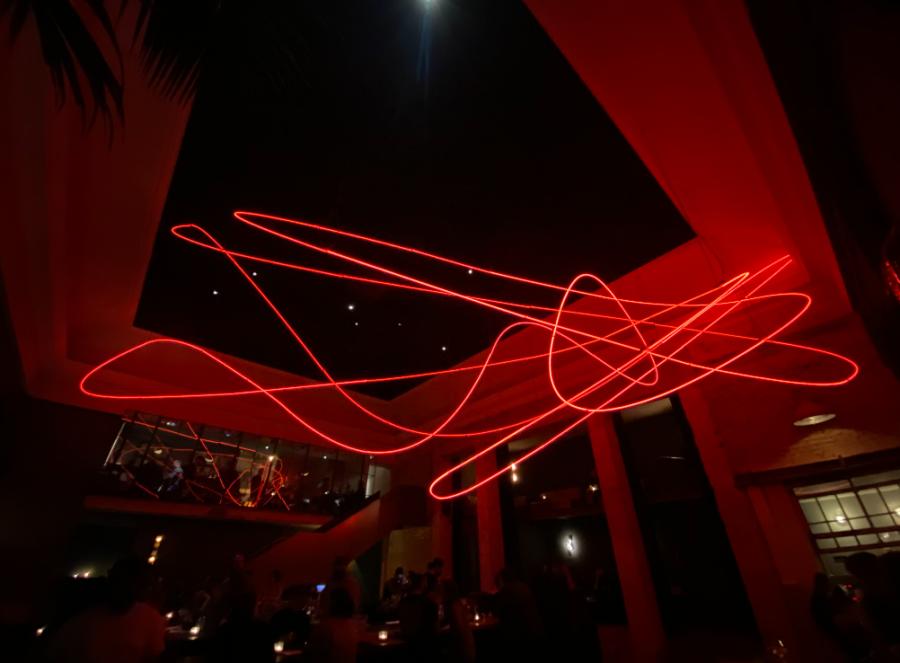
The exhibition brings together three major works: a room-filling installation on the floor, a neon work suspended from the ceiling – like an intricate drawing in space – and a grid of around a hundred framed ink drawings on the wall.
A diversity of techniques, materials and formats: ink on paper, wood, metal, light. All the works are linked by a shared interest: space as a place of atmosphere, movement and encounter. The installation offers more than one hundred visitors the opportunity to sit down and become part of it. At the centre of the hall, within the installation, is an open space. A space of possibility.
Kerim Seiler is influenced by the practices of the Situationists. For them, art was not merely to be viewed, but experienced and lived. Guy Debord coined the term dérive. He used it to describe aimless wandering through public space, without following predetermined routes or pursuing fixed destinations. One allowed oneself to be guided by the atmosphere, architecture, absurd self-imposed rules or social situations. This led to unexpected situations and encounters. The journey to the exhibition is almost a dérive in itself: in Weißensee, beyond the S-Bahn ring, past a Lidl and a vacant lot – a brass bell on an old, unrestored former East German factory. The door opens and you find yourself in a white cube. If you do not already know the place: an unexpected situation!
A central concept of the Situationists is psychogeography: the study of the interplay between the spatial environment and human perception, movement and behaviour. Unlike the Situationists, who were less interested in producing finished works, Seiler creates autonomous objects. These, too, can alter an atmosphere, direct the gaze, influence movement and create possibilities for encounters – and, indeed, situations!
Seiler regards his works as interventions in space. They alter the conditions under which we perceive and use a space. The installation on the floor becomes a meeting place and a stage. Where one sits, who you meet, what you perceive – nothing is predetermined.
As a counterpoint, there is the strict grid of ink drawings. Almost instinctively, one begins to interpret the ink drawings like Rorschach tests, searching for meanings, even though they are, first and foremost, forms and colours without any fixed meaning. Like the objects, the ink drawings are not merely looked at; they trigger movements – this time within us. Our interpretations – and here the circle is complete – are in turn dependent on our particular situation. If, for example, we are troubled, we see something different from when we are unburdened. Thus, the exhibition and the situations it gives rise to influence how we interpret each individual ink drawing.
Seiler's exhibition The Title Comes Last is a stage on which no predetermined play is performed. What happens emerges through the visitors, their behaviour and their inner experience. No one has memorised a script. Seiler describes his art with the phrase „Space is my canvas" – first space, then movement, then encounter. You never know what will happen. The name follows the situation, not the other way around. The title comes last.