OSZILLATIONEN (OSCILLATIONS) between order and chaos
OSZILLATIONEN (OSCILLATIONS) between order and chaos
Hans-Peter Klie and Andreas Schmid
In contrast to many Western traditions, in which chaos and order are seen as opposites, Far Eastern philosophies tend to dissolve this polarity into a greater whole. While modern chaos theory defines the limits of determination from within from a scientific perspective, Far Eastern philosophy offers a holistic framework in which chaos and order can be understood as complementary aspects of reality.
Far Eastern philosophy can therefore offer an alternative to the deterministic world view that has long dominated Western science. It enables an understanding in which the world oscillates between order and chaos without one of the two principles being regarded as fundamentally superior or desirable.
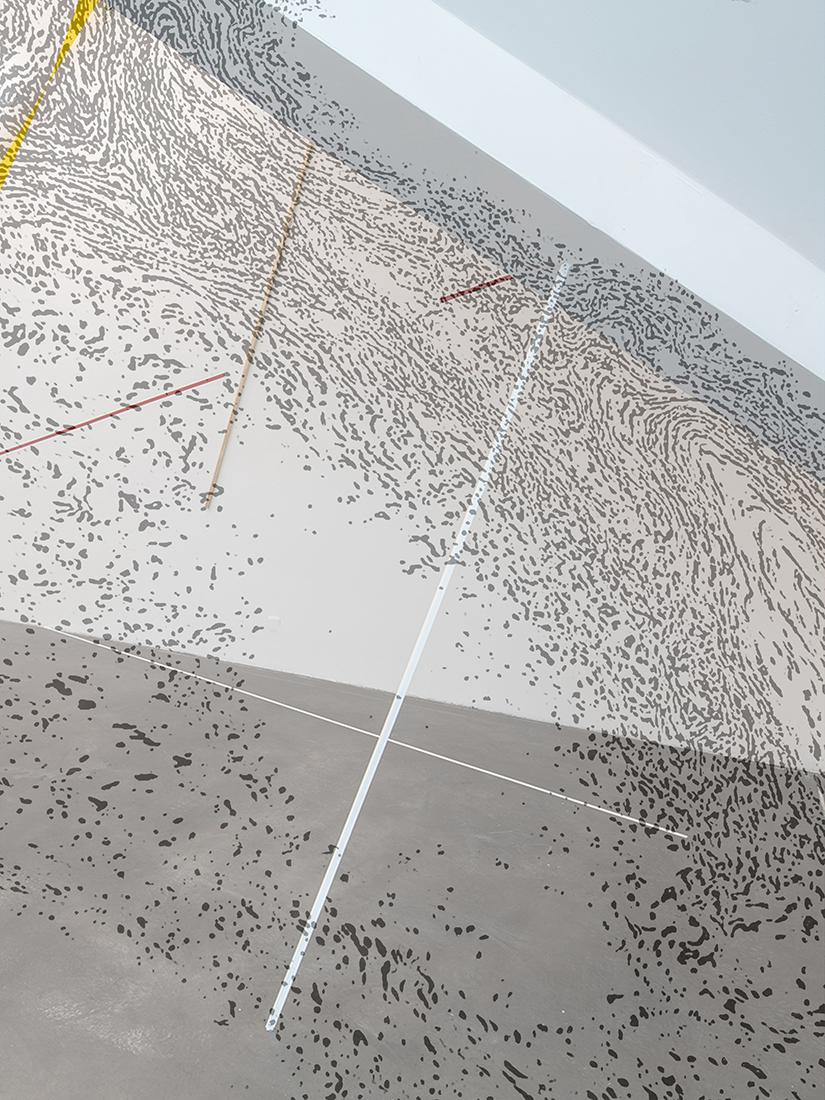
In their joint concept, Hans-Peter Klie and Andreas Schmid create an interplay of components that utilises metaphors as a connecting element in terms of form and content, illustrating that the world oscillates between order and chaos.
Hans-Peter Klie uses video and photographic works to make the principles of chaotic systems tangible and vivid. He shows flow fields in snapshots and in motion. They were created after days of downpours, which led to exponential algae growth within a river in the run-off water from the mountainous regions of southern Norway. These flow images, located ‘between the Milky Way and microscopic cell structures’, become a metaphor for the flow of time within which they emerge and disappear. They form a visual, cognitive bridge between abstract concepts and reality.
Metaphors also create a meta-perspective: with his complex spatial structures, the often contradictory perspective approaches with lines and spatial axes, Andreas Schmid opens up the space and the perspective in it and on it in two ways. Using such diverse means as drawn, painted, cut lines, lines drawn with string or light sources, he evades the seemingly necessary, unambiguous localisation and encourages reflection on complex relationships by creating new tangible forms. The systems oscillate.
Klie and Schmid create metaphors to differentiate the term chaos, because in the Western sense it often only describes a state that follows no recognisable rules and in which no pattern can be identified.
The fact that the rule and its meaning are missing at first glance is a gain for Klie and Schmid.