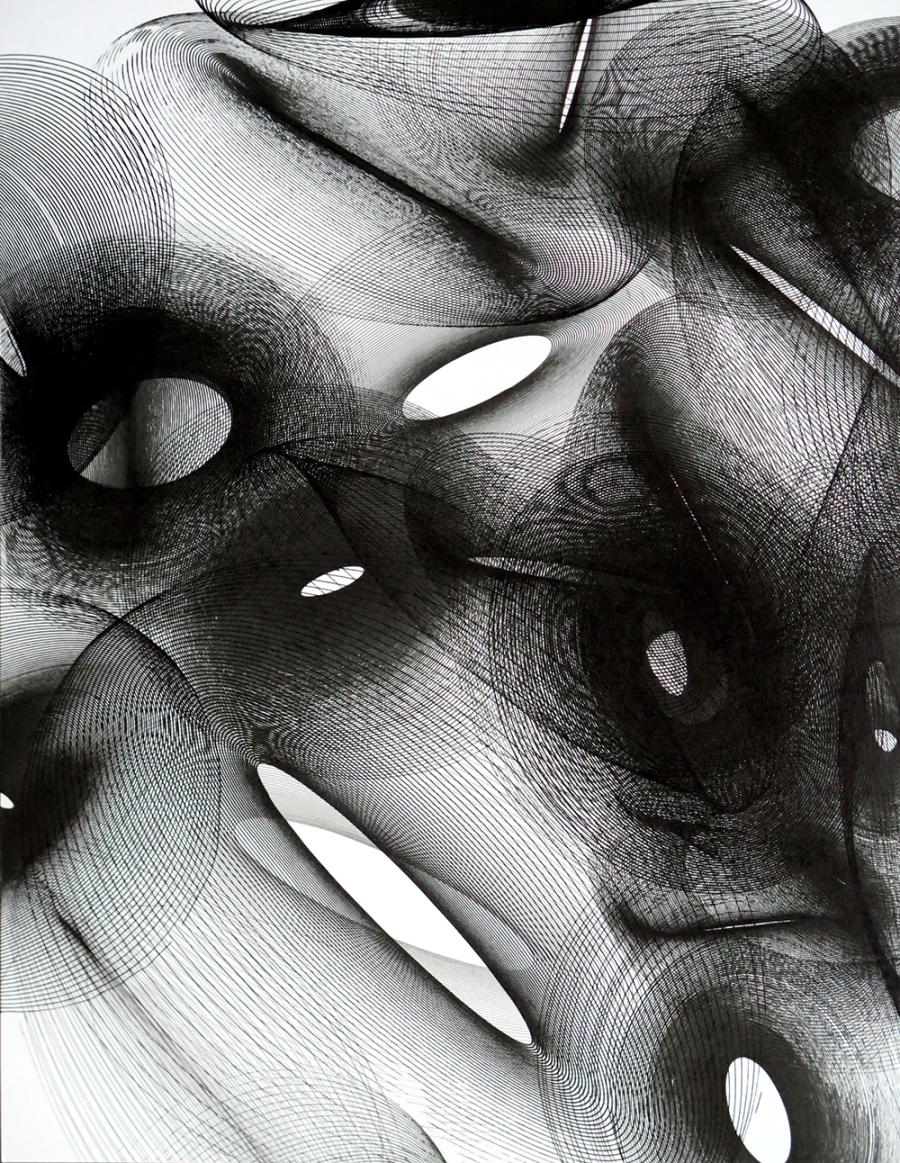
Wirrwarr Jan Klopfleisch, Maja Rohwetter, Alexandra Schlund
Fri, 10 Oct 2025 19:00at SCOTTY
Wirrwarr Jan Klopfleisch, Maja Rohwetter, Alexandra Schlund
The exhibition presents three artistic positions that understand chaos not as a disturbance, but as a creative principle, engaging with the unpredictable and the processual.
Jan Klopfleisch experiments with a self-built harmonograph whose pendulum movements generate figures that are at times orderly, at times chaotic, condensing into complex structures.
In her wall painting, Alexandra Schlund subverts every familiar sense of spatial order – above and below dissolve, and a fluid spatial perception emerges.
Maja Rohwetter extends painting into the digital: in her augmented reality work, virtual fragments respond to visitors' movements, merging with sound and surroundings into a constantly re-forming collage.
As different as the media and methods may be – from mechanical drawing to collage and wall painting, and on to digital extension – the artistic approaches revolve around a shared concern: making visible dynamic processes that keep our perception of space, image, and reality in constant motion.
The title Wirrwarr (tangle, entanglement) does not refer to mere disorder, but to the productive interweaving of forms, movements, and perceptions that becomes tangible in the works.
Jan Klopfleisch engages with optical phenomena and dynamic processes of perception. His works are characterized by simple basic structures, openness, and transformability. He explores fundamental pictorial possibilities beyond abstraction and representation.
The drawings shown in the exhibition were created with a harmonograph built by Jan Klopfleisch himself — a mechanical, pseudo-scientific drawing machine that was rediscovered and became popular in the 19th century. It transforms the oscillations of several pendulums into linear movements and drawings of complex figures. Depending on how the pendulums swing in relation to one another, chaotic or ordered figures emerge, visually rendering frequencies and oscillations — that is, sounds and tonal relationships — in extreme slow motion. Klopfleisch is particularly fascinated by the figure of the spiral, the most harmonious form. Through multiple superimpositions of the drawings, he generates complex, dynamic, and condensed structures and spaces. The process of drawing consists of both mechanical procedure and intuitive intervention.
Maja Rohwetter's "Contingencies" is an augmented reality work in which virtual fragments of painting interact with the user and with the actual physical environment.
The forms reference pictorial elements from Rohwetter's paintings and collages. Fundamental painterly questions — such as the relationship between gesture and illusion, space and surface, image and movement — are addressed through animated pictorial elements that respond to the viewer's approach and to their movements in real space. Each visual element has also been translated into sound, so that in using the AR application a visual and auditory collage emerges, in which real and digital realities overlap.
The work Contingencies is made accessible through the app appARition, developed by Maja Rohwetter in collaboration with Artvisity and the Aurora School for ARtists at HTW. The app can be downloaded free of charge from the App Store and becomes part of the exhibition either on visitors' own devices or on an iPad provided on site. The AR experience appears after scanning a real image in the exhibition, which serves as the reference point for positioning the objects in space and determining their size, and which opens access as a kind of "portal."
Alexandra Schlund creates pictorial worlds that do not follow a perspectivally logical spatial representation but instead question the familiar relationship between viewer and environment. In her work, the artist engages with architectural spaces that seem boundless and convey a fleeting sense of space. By means of irrationally fractured perspectives, the use of multiple vanishing points, and intersecting diagonals, conventional principles of order are suspended, producing a fluid spatial sensation. Schlund transfers this into new spatial and semantic contexts through collage techniques, enabling variable readings depending on the viewer's perspective. Her focus lies on reduced, flowing spatial constructions that address the interplay between surface, spatiality, and boundlessness. To this end, she draws on forms of urban architecture, from which she derives a technoid-abstract formal language and invents new spaces.
For the exhibition at SCOTTY, she is developing a site-specific wall work made of paper and adhesive tape.